
We're Building a Future Where Anyone Can 3D Print Anything.
String Cubed develops 3D-printing materials for things you'd never expect from a printer: think soap that lathers, seed pods with built-in water and nutrients, and even filters that clean seawater. With eight functional materials already commercialized through our sister company, we're working to bring our first voice-powered home printer to market.
Become an early-stage investor today.
Home 3D Printers Are Waiting for Their App Store Moment
Smartphones took off once apps gave people a reason to use them. We believe the right materials can do the same for home 3D printers. If String Cubed is successful, the printer in your home could make the everyday goods that now get shipped to you.
$31.8B
Projected global 3D printing market by 2032.
5M+
3D printers exported from China in 2025.
$12.6B
Projected programmable matter market by 2035, our category
If Home 3D Printers Are Already Selling By The Million, Why Are They Still Printing Plastic?
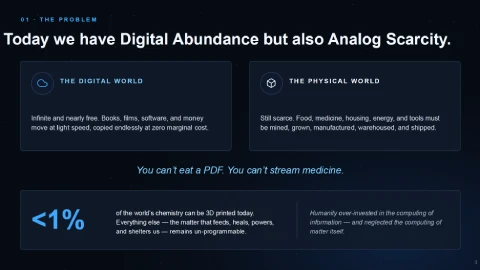
You can stream a movie or download a book in seconds. But the soap by your sink and the vitamins in your cabinet still travel through a factory, a warehouse, a truck, and a store before they reach you. The 3D printers already in homes could change that, but two things are holding them back:
01
Heat
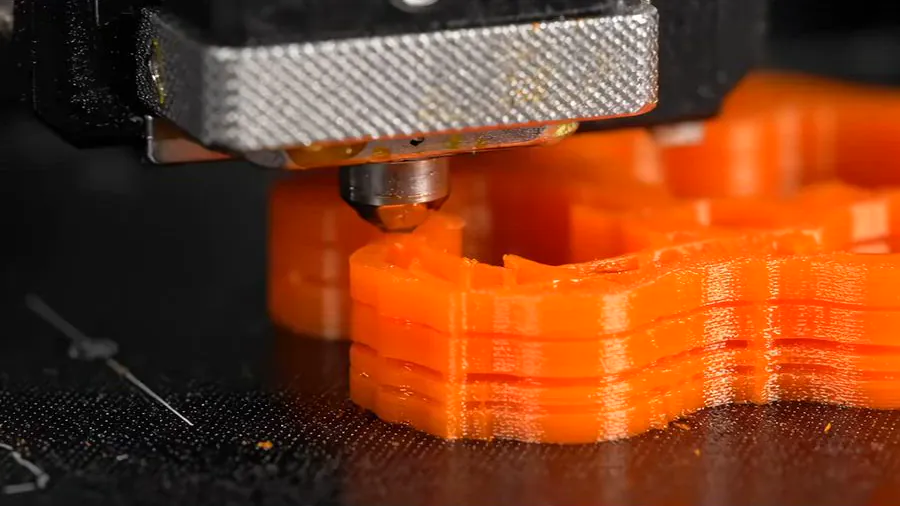
A printer melts material at 200°C. Most of the chemistry that makes an object useful breaks down around 60°C. Proteins, medicines, and nutrients can't survive.
02
Power
The World Runs on Two Kinds of Computing
Most of the modern world runs on digital. String Cubed works on the analog side: materials that do a job on their own, with no chip or battery.
digital computing
Using chips and code to solve a problem.
analog computing
Using a physical system, like gears or flowing water, to solve a problem instead of using digital code.
“Manifester, Make Soap.”
Meet the Manifester, the home printer you run with your voice.
We're designing it from the ground up to use functional materials instead of plastic.
Load a cartridge.
Say what you need.
Get something you can use.
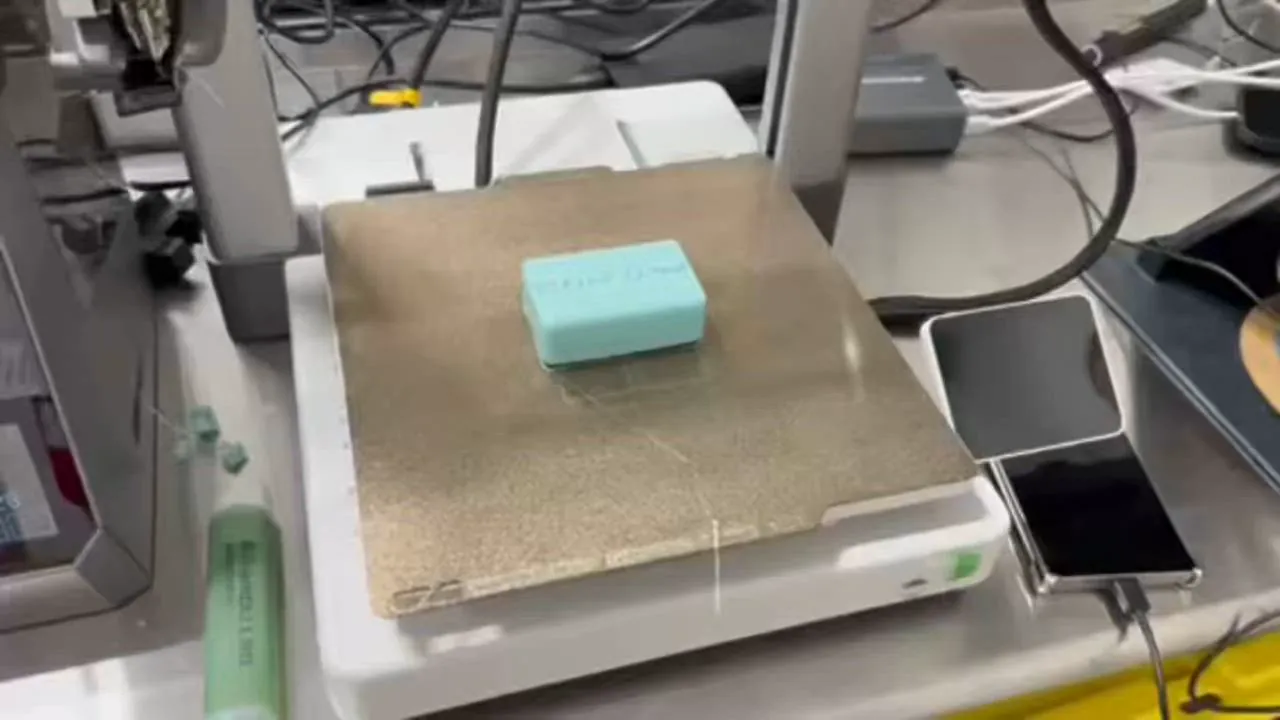
Eight of our functional materials are already commercialized through our sister company, Timeplast. Each one could become a Manifester cartridge.

Soap
What we believe is the world's first 100% 3D-printed soap bar.
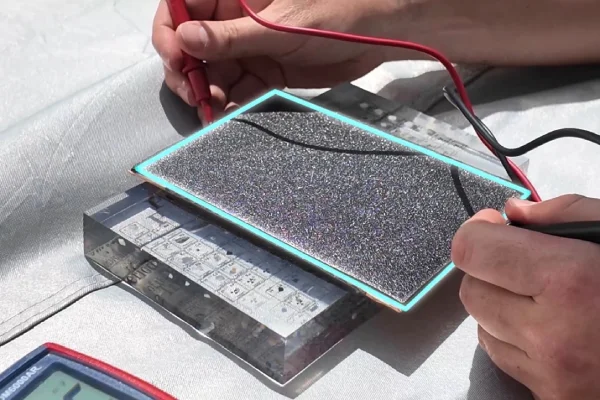
Solar
A printable material that turns light into electricity.

Desalination
A filament designed to pull salt out of seawater.
Plus five more
Bloominite, food that grows itself
A printed seed pod with its own water and nutrients, released in the right order.
Air-to-water well
A printed structure designed to pull drinking water out of humid air.
Timed-release medicine
Printed capsules designed to release medicine on a set schedule.
Timeplast Proves This Chemistry Works Outside the Lab
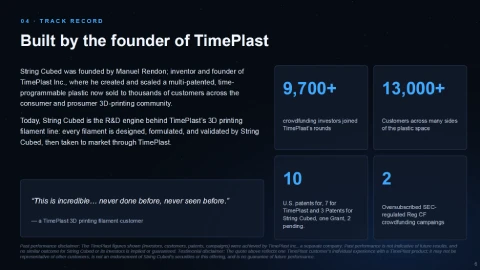
Our founder, Manuel Rendon, also founded Timeplast, which sells our functional materials and holds the exclusive license to sell the Manifester.
Made at scale
Timeplast's material runs through standard factory processes.
Real customers
It has shipped our materials to thousands of customers.
Our first customer
Timeplast pays us development fees.
Inside the Timeplast lab in Florida.
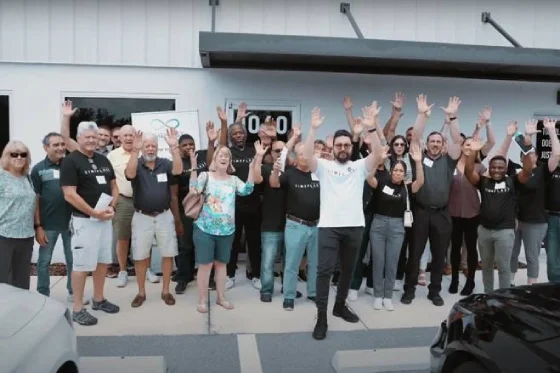
Manuel with Timeplast investors and team at the Florida facility.
Two Breakthroughs Make the Manifester Possible
Problem 1: Heat
1. Vapor-Cooling 3D Printing
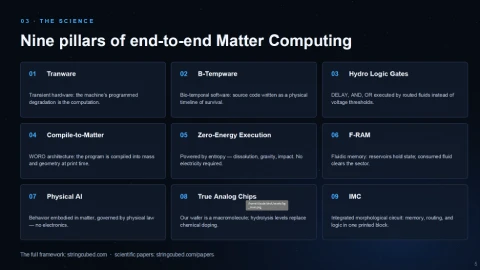
Our printing material carries its own water. At 200°C, that water turns to steam and soaks up the heat, so a standard printer can make soap, plant nutrients, real protein, and solar material.
Problem 2: Power
2. Objects That Run on Their Own
Our printed objects keep working on their own. They're built in layers that dissolve in water one at a time, like the coating on a pill, and each layer lets something out on schedule.
One Revenue Line Today, Four More Planned
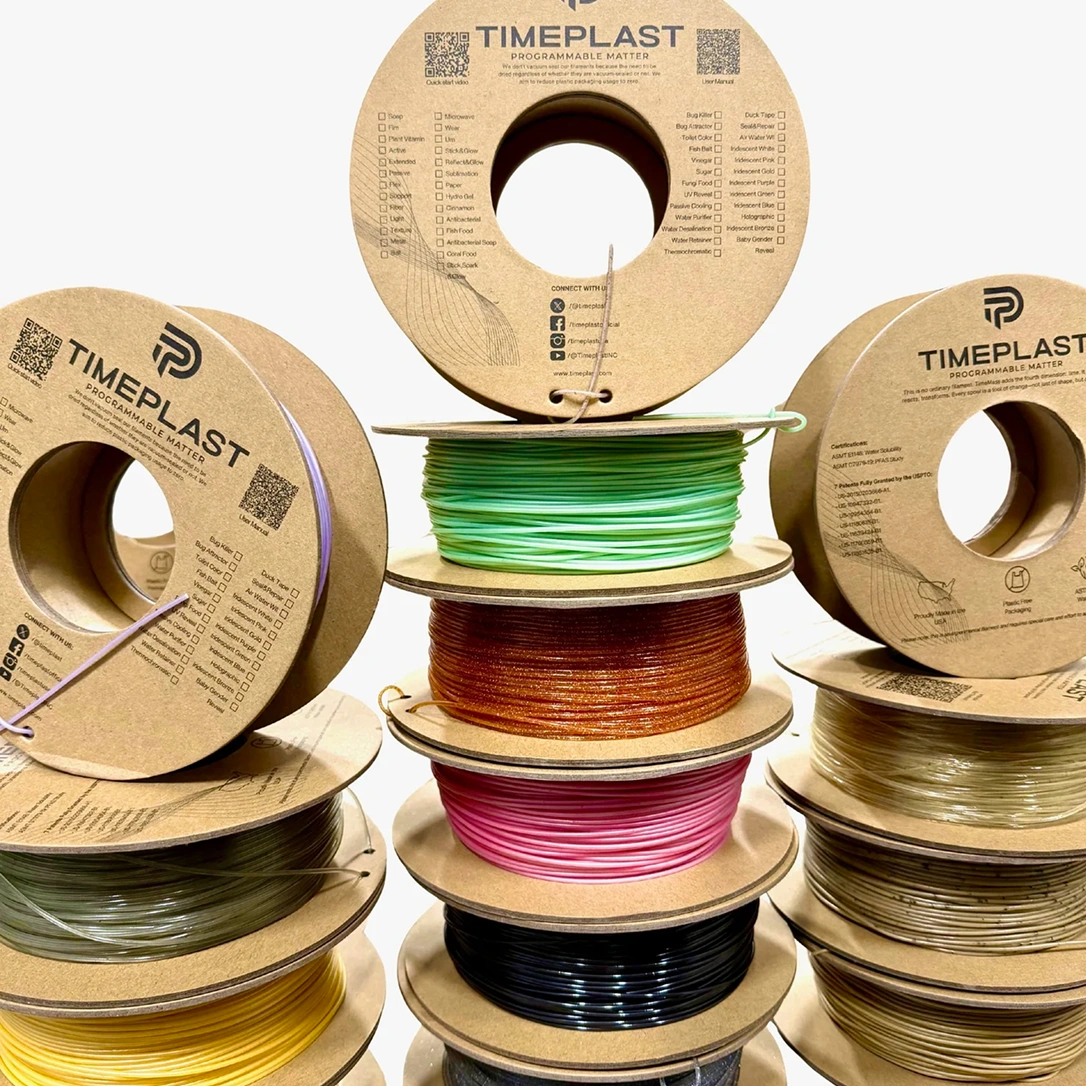
Filament development
A monthly fee from Timeplast
TimePen
$100 retail · 50% margin
Bloominite
$10 retail · 25% margin
Every Manifester sold
Our costs plus 30% of the profit
Every design sold
70% of each sale in the Object Store, the Manifester's app store


How Could You See a Return on Your Investment?
String Cubed is a private company, so its shares don't trade on a stock exchange today. If the company succeeds, here are the ways you could see a return.
01
A larger company buys String Cubed
A company in manufacturing, materials, or consumer goods could buy String Cubed to own its patents and materials. Shareholders typically receive cash or stock based on how many shares they own.
02
String Cubed goes public
If the company grows large enough to list on a stock exchange, your shares could become tradable, so you could sell them after any required waiting period.
03
You sell your shares to another buyer
Reg CF shares generally can't be resold for one year. After that, you may be able to sell them privately, though no public market exists and one may never develop.
We Project Nearly 4X Annual Revenue Growth by Year 3
We expect to keep about 77 cents of every dollar we earn, after the cost of making our products. Here's how we plan to get there.
IP & Core Technology
Materials and Licensing
The Manifester
Making Things Where They're Needed
Our Founder Has a Track Record of Doing the "Impossible"

“
I believe the key to material abundance is a technology platform capable of allowing any healthy human being to grow their own food, build their own home, generate electricity from the sun by themselves, store energy, manufacture tools, and even terraform their own living space.
Manuel Rendon
Environmental engineer
Chemistry focus.
Former PepsiCo
Global supply chains.
Founded Timeplast
String Cubed affiliate.
Named inventor
US Patent 12,564,142.
Become a String Cubed Investor in Just a Few Steps
It takes just a few minutes to invest through a simple, secure checkout powered by DealMaker.
01. Choose Your Investment
02. Complete Checkout
03. We’ll Keep You Posted
Turn Your Investment Into More Shares
- Virtual tour of the Company’s facilities, and a physical tour of the facility.
- Virtual tour of the Company’s facilities, a physical tour of the facility, and a virtual meeting with the Founder.
- Virtual tour of the Company’s facilities, a physical tour of the facility, a virtual meeting with the Founder, and an in-person meeting and lunch with the Founder.
- Virtual tour of the Company’s facilities, a physical tour of the facility, a virtual meeting with the Founder, an in-person meeting and lunch with the Founder, and a strategic meeting with the Founder.
- Virtual tour of the Company’s facilities.
- Virtual tour of the Company’s facilities, and a physical tour of the facility.
- Virtual tour of the Company’s facilities, a physical tour of the facility, and a virtual meeting with the Founder.
- Virtual tour of the Company’s facilities, a physical tour of the facility, a virtual meeting with the Founder, and an in-person meeting and lunch with the Founder.
- Virtual tour of the Company’s facilities, a physical tour of the facility, a virtual meeting with the Founder, an in-person meeting and lunch with the Founder, and a strategic meeting with the Founder.
Frequently Asked Questions
Why invest in startups?
Regulation CF allows investors to invest in startups and early-growth companies. This is different from helping a company raise money on Kickstarter; with Regulation CF Offerings, you aren't buying products or merchandise - you are buying a piece of a company and helping it grow.
How much can I invest?
Accredited investors can invest as much as they want. But if you are NOT an accredited investor, your investment limit depends on either your annual income or net worth, whichever is greater. If the number is less than $124,000, you can only invest 5% of it. If both are greater than $124,000 then your investment limit is 10%.
How do I calculate my net worth?
To calculate your net worth, just add up all of your assets and subtract all of your liabilities (excluding the value of the person's primary residence). The resulting sum is your net worth.
What are the tax implications of an equity crowdfunding investment?
We cannot give tax advice, and we encourage you to talk with your accountant or tax advisor before making an investment.
Who can invest in a Regulation CF Offering?
Individuals over 18 years of age can invest.
What do I need to know about early-stage investing? Are these investments risky?
There will always be some risk involved when investing in a startup or small business. And the earlier you get in the more risk that is usually present. If a young company goes out of business, your ownership interest could lose all value. You may have limited voting power to direct the company due to dilution over time. You may also have to wait about five to seven years (if ever) for an exit via acquisition, IPO, etc.
Because early-stage companies are still in the process of perfecting their products, services, and business model, nothing is guaranteed. That's why startups should only be part of a more balanced, overall investment portfolio.
When will I get my investment back?
The Common Stock (the "Shares") of String Cubed (the "Company") are not publicly-traded. As a result, the shares cannot be easily traded or sold. As an investor in a private company, you typically look to receive a return on your investment under the following scenarios:
- The Company gets acquired by another company.
- The Company goes public (makes an initial public offering).
In those instances, you receive your pro-rata share of the distributions that occur, in the case of acquisition, or you can sell your shares on an exchange. These are both considered long-term exits, taking approximately 5-10 years (and often longer) to see the possibility for an exit. It can sometimes take years to build companies. Sometimes there will not be any return, as a result of business failure.
Can I sell my shares?
Shares sold via Regulation Crowdfunding offerings have a one-year lockup period before those shares can be sold under certain conditions.
Exceptions to limitations on selling shares during the one-year lockup period
In the event of death, divorce, or similar circumstance, shares can be transferred to:
- The company that issued the securities
- An accredited investor
- A family member (child, stepchild, grandchild, parent, stepparent, grandparent, spouse or equivalent, sibling, mother-in-law, father-in-law, son-in-law, daughter-in-law, brother-in-law, or sister-in-law, including adoptive relationships)
What happens if a company does not reach their funding target?
If a company does not reach their minimum funding target, all funds will be returned to the investors after the close of the offering.
How can I learn more about a company's offering?
All available disclosure information can be found on the offering pages for our Regulation Crowdfunding offering.
What if I change my mind about investing?
You can cancel your investment at any time, for any reason, until 48 hours prior to a closing occurring. If you've already funded your investment and your funds are in escrow, your funds will be promptly refunded to you upon cancellation. To submit a request to cancel your investment please email: investors@dealmakersecurities.com
How do I keep up with how the company is doing?
At a minimum, the company will be filing with the SEC and posting on its website an annual report, along with certified financial statements. Those should be available 120 days after the fiscal year end. If the company meets a reporting exception, or eventually has to file more reported information to the SEC, the reporting described above may end. If these reports end, you may not continually have current financial information about the company.
What relationship does the company have with DealMaker Securities?
Once an offering ends, the company may continue its relationship with DealMaker Securities for additional offerings in the future. DealMaker Securities' affiliates may also provide ongoing services to the company. There is no guarantee any services will continue after the offering ends.
What is String Cubed's pre-money valuation?
String Cubed's pre-money valuation is $40M. The valuation was calculated by multiplying the total number of shares outstanding (TSO) by the price per share offered in this raise. This is a pre-money valuation, meaning it reflects the company's value before any new funds raised in this offering are added.